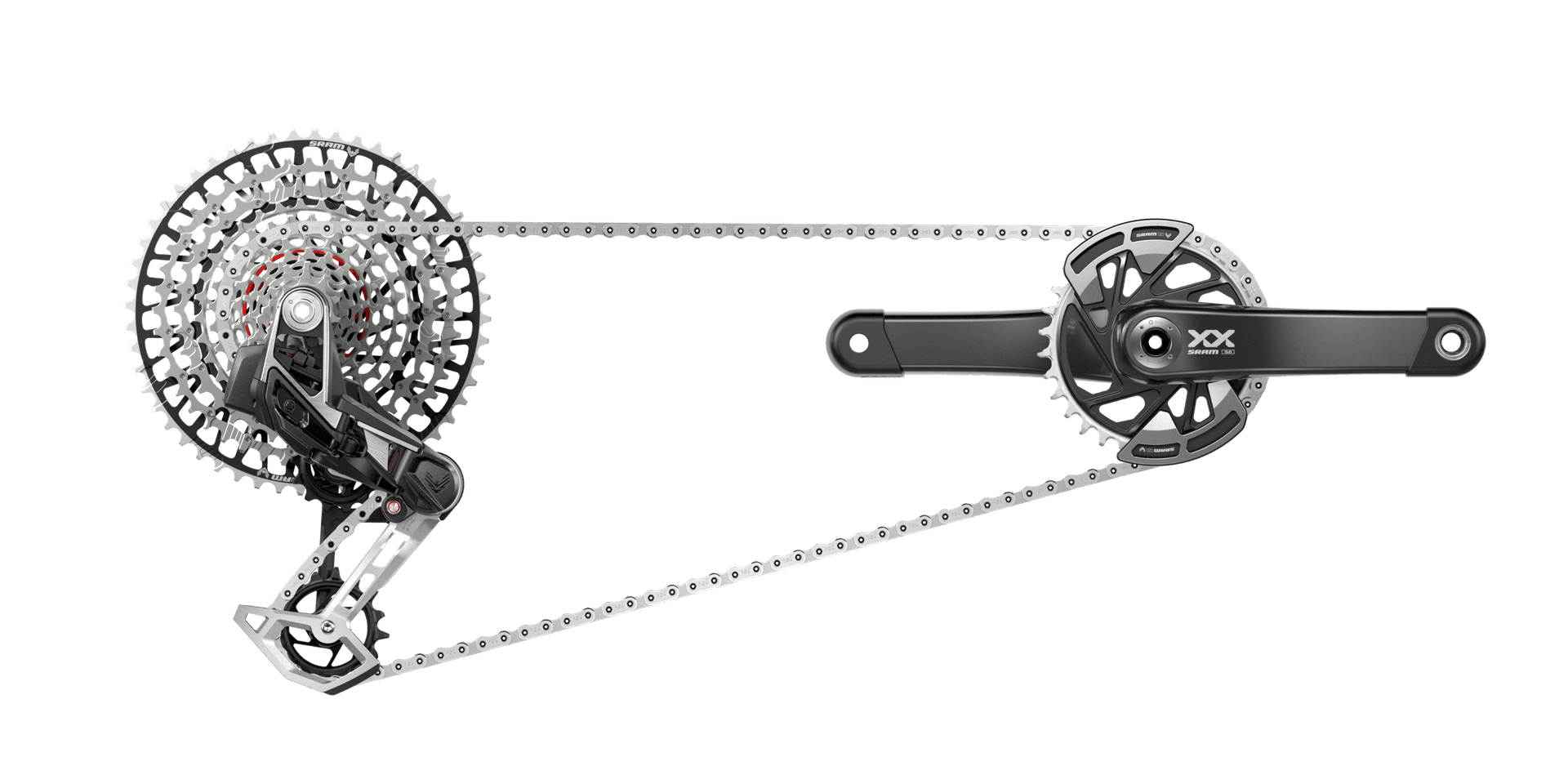
Chains don't really stretch. The plates stay the same length. What wears is the pins and the inside of the rollers and bushings. Every joint picks up a tiny bit of play, and over 100-plus links that adds up to a chain that's measurably longer than new. A long chain no longer sits properly between the teeth. It rides up the tooth flanks and slowly grinds the cassette and chainring into the same worn shape.
That's why it's worth checking. A chain is cheap next to a cassette. Swap the chain on time and one cassette and chainring can outlive several chains. Leave it too long and you'll be buying all three.
Why eMTB chains wear faster
An eMTB chain carries your power and the motor's. Full-power motors now make 85 to 150 Nm, and all of that goes through the pins, especially when you shift under load on a steep climb. Add mud, sand and water and you've got grinding paste. So check an eMTB chain more often than on a regular bike, and think about an e-bike chain with hardened pins or stronger plates. Most drivetrain brands make one now.
What the numbers mean
Chain wear is measured as a percentage of extra length. At 0.5% many brands tell you to replace narrow 11- and 12-speed chains, and if you do it here the cassette usually survives. 0.75% is a common limit for older, wider chains, but on a modern 12-speed drivetrain it's often already too late. At 1% or more the cassette and chainring are very likely worn too, and a new chain will probably skip.
Go by the limit your drivetrain maker gives. SRAM, Shimano and others publish their own figures, and some sell matching checkers.
Method 1: chain checker
Method 2: steel ruler (most accurate at home)
- 01Use a 12-inch (305 mm) steel ruler 12 inches equals exactly 24 half-links on a bicycle chain.
- 02Line up a pin with the zero mark Hold the chain under tension on the top run.
- 03Look at the pin at 12 inches On a new chain it sits exactly on the 12-inch mark.
- 04Read the difference About 1/16 inch (1.5 mm) past the mark ≈ 0.5 % wear; about 3/32 inch (2.3 mm) ≈ 0.75 %.
How often to check
On an eMTB in normal use, check every 300 to 500 km, or every few rides when it's wet and muddy. Check after every wet or muddy multi-day trip, and any time shifting gets noisy or the chain skips under load.
A small habit that pays off: note the date or the motor's odometer reading when you fit a new chain. After a couple of chains you'll know how long they really last on your bike.
Is the cassette worn too?
The clearest sign is a new chain that skips under load on the cogs you use most, even though the gears are indexed properly. You can also look at the teeth. If they look hooked or shark-finned instead of symmetrical, they're worn. On the chainring, watch for a chain that sits high on the teeth or doesn't drop off cleanly.
If a new chain skips, replace the cassette, and often the chainring too. Putting the old chain back on only buys you a little time.
Fitting a new chain
- Buy the right chain. SRAM Eagle T-Type (Flattop) chains for SRAM Transmission, LinkGlide chains for Shimano LinkGlide, and 12-speed chains for 12-speed Hyperglide+. Mixing systems makes shifting worse.
- Get the length right. Copy the old chain's link count only if it was correct. Otherwise use the maker's sizing method. SRAM Transmission uses a length chart based on chainstay length and a sag gauge.
- Use a new quick link. Most are made to be used once.
- Check the direction. Many modern chains only go on one way.
- Lube sparingly. If the maker says so, clean off the extra factory grease first, then lube and wipe the outside.
Make it last longer
Clean and lube after wet rides, because a clean, dry chain wears far slower than a gritty one. Ease off the pedals for a moment when you shift, so you're not changing gear under full motor power, especially on climbs. Drop to a lower assist mode in thick mud, and don't sit in extreme cross-chain gears for long.
You'll find eMTB drivetrains in our components catalog.

32 years of riding experience, from a school bike to today's high-tech e-MTBs. My goal is to build the most complete and accessible e-MTB catalog to make choosing easier, and to bring our readers the latest news.