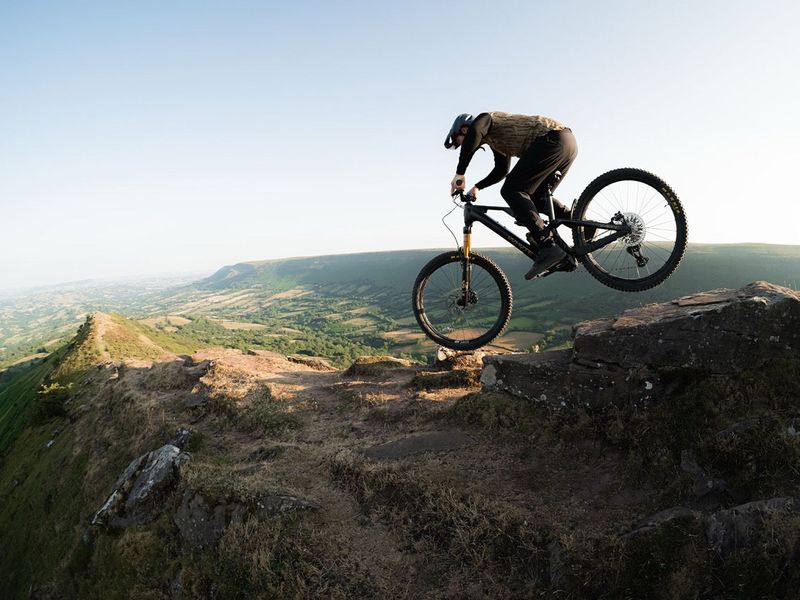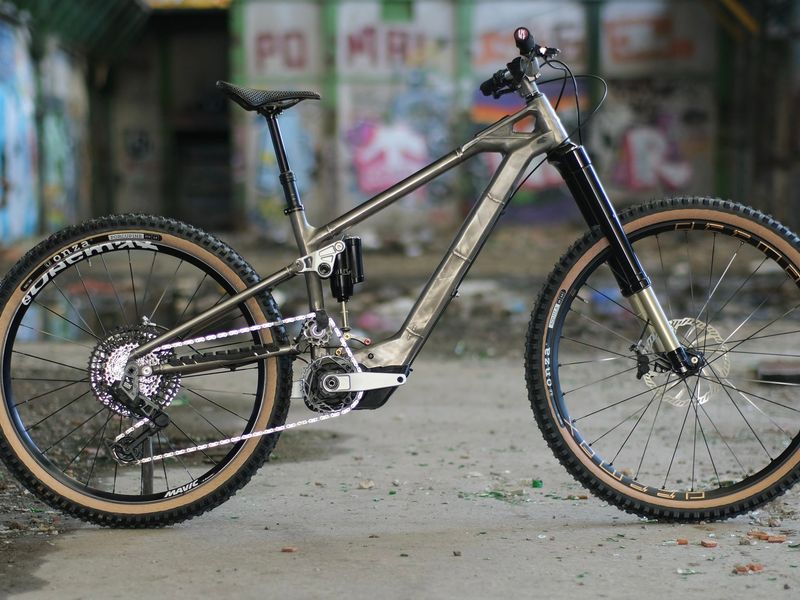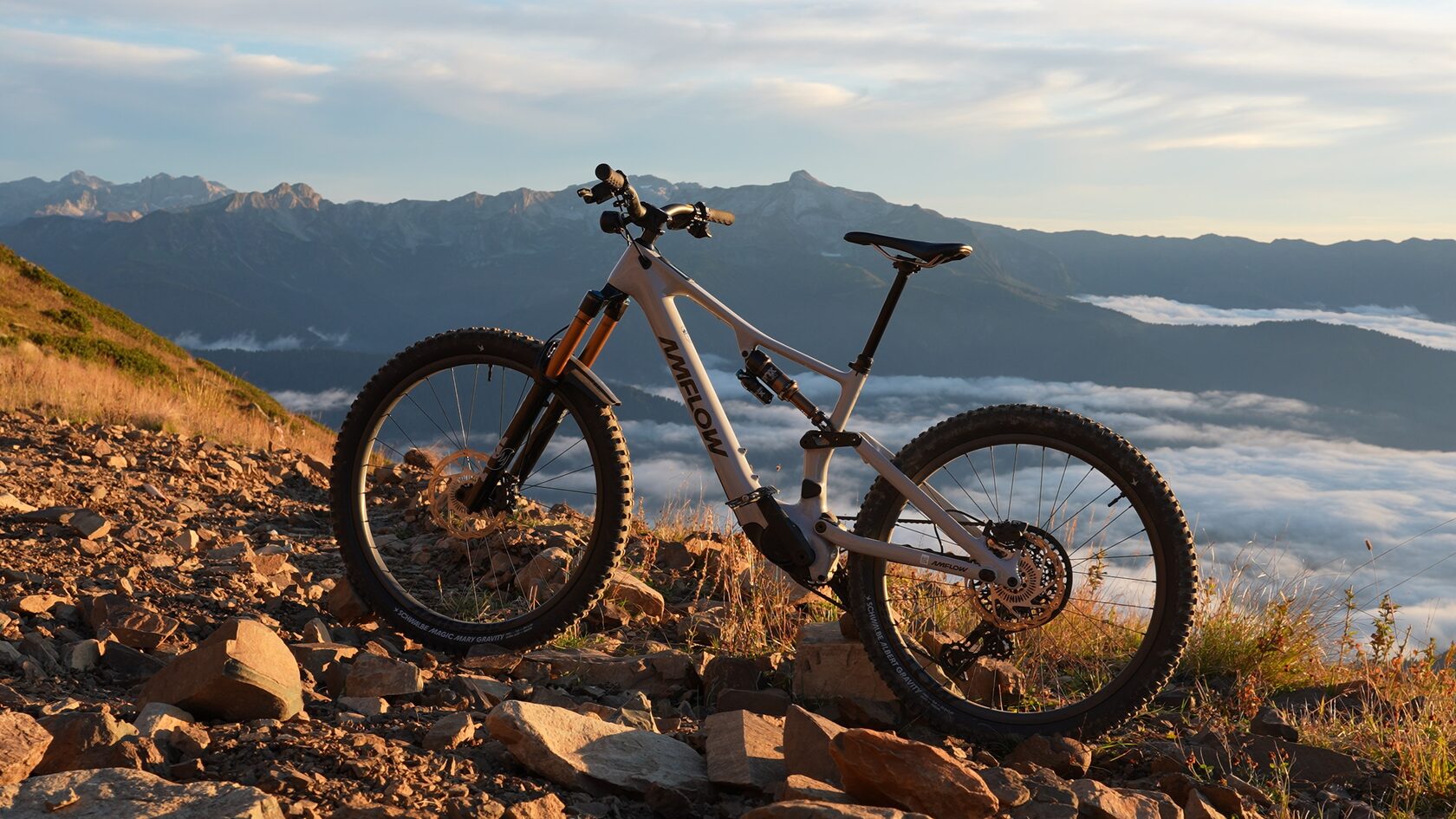
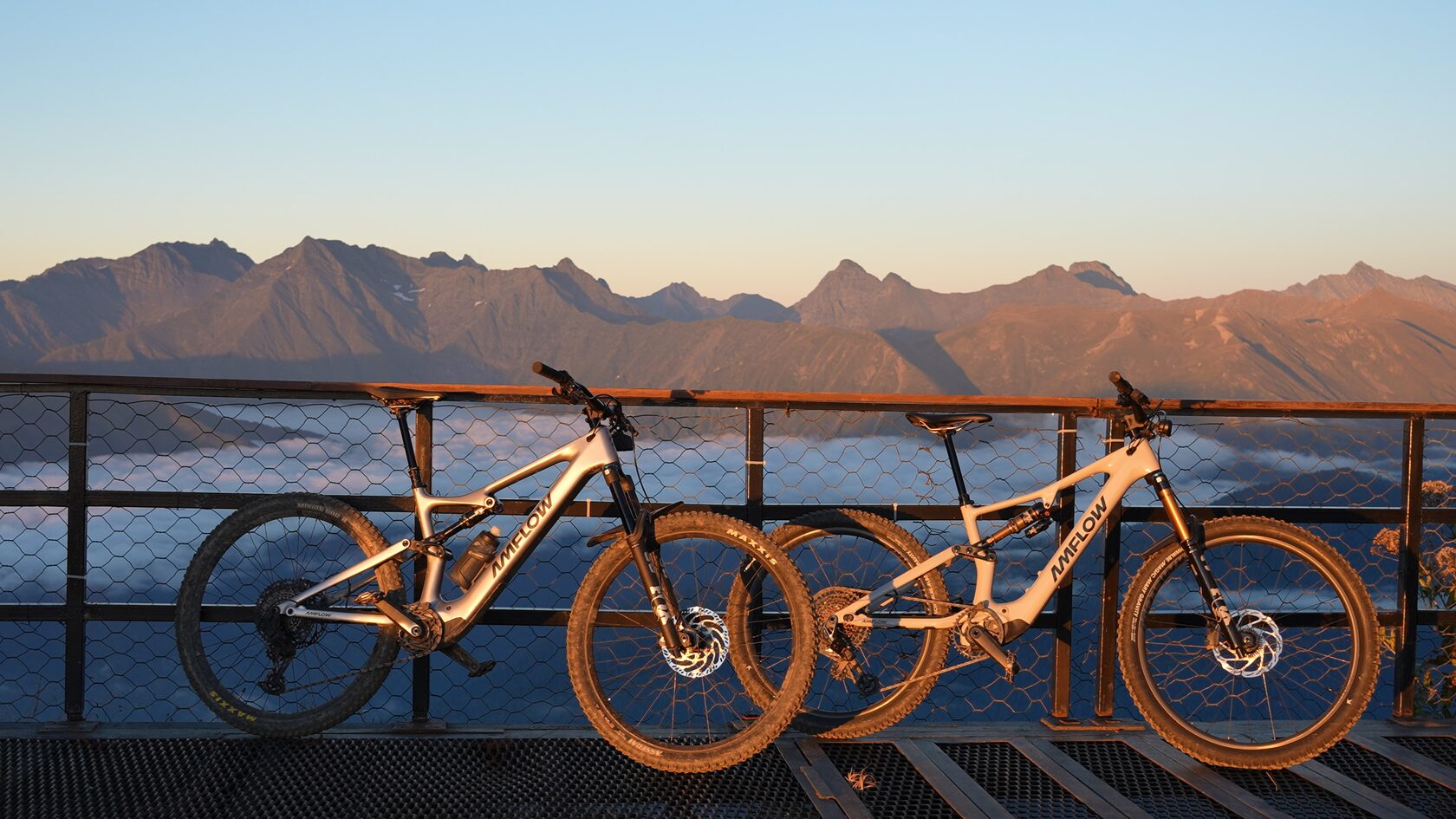
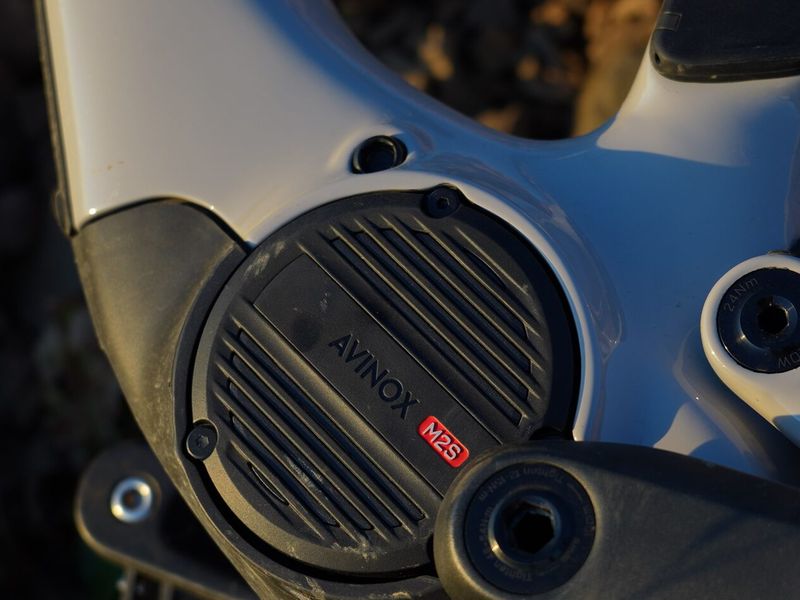
I got my first rides on the new Amflow PX Pro with the DJI Avinox M2S motor, on my home mountain trails. The parts list leaves nothing to argue about: a Fox 36 Factory with the new GRIP X2 damper, Magura Gustav Pro brakes, carbon rims. But the real story is that Amflow reworked both the frame and the motor, and the change is big.
Amflow PX Pro frame and weight
The first thing that struck me came before I even rode it: the tubes. The frame is about the same size as a normal enduro or trail bike without a motor. It is hard to believe there is the most powerful motor on the market in there, plus a full-size 700 Wh battery. Next to the PX, the Amflow PL, which looked slim only a year ago, suddenly seems bulky. My size M weighs 20.6 kg.
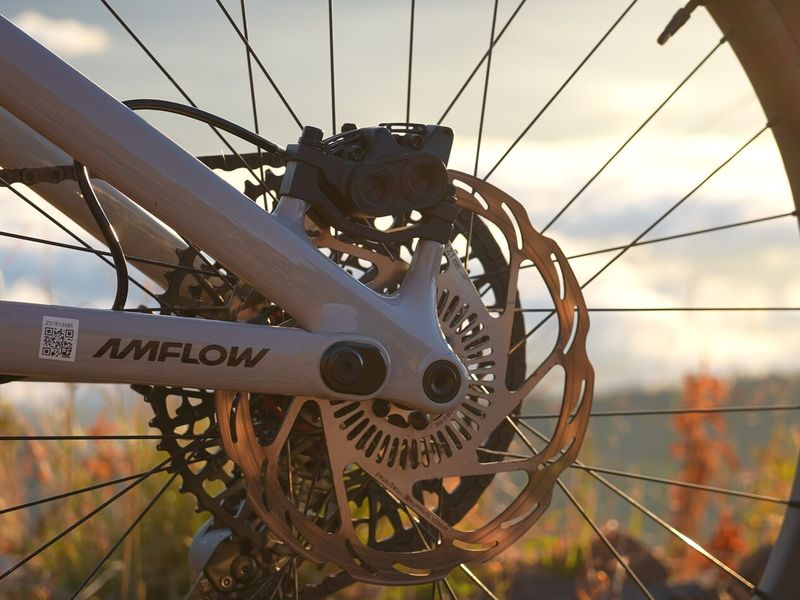
One small detail: the speed sensor ring now sits directly on the brake rotor.
Radial tyres straight from the box
The PX Pro ships with heavy-duty Schwalbe tyres with radial casing (Magic Mary front, Albert rear). The radial construction is meant to keep a large contact patch even at higher pressures, and Schwalbe claims around 30% more than usual. In practice, on sections where I spun out on a Maxxis DHR 3C MaxxGrip, the PX kept climbing without slipping.
From Bosch to Avinox
I rode Bosch Gen4 and the Smart System for three years: a good, reliable motor with 85 Nm and 750 W peak. When I moved to the Avinox M1, 105 Nm and 1,000 W felt like a real step up. I climbed faster and cleared rocky, rooty climbs I could not do on the Bosch. The M1 seemed to have huge reserves, and Bosch's eMTB mode started to feel like the M1 just above Eco.
How the M2S feels
With the M2S, the M1 now feels the way the Bosch used to. Ride the two side by side at an easy pace and you notice no difference. Start pushing hard, though, and the M1 rider is spinning at maximum heart rate while the M2S rider climbs with relaxed pressure on the pedals.
So the M2S gives you a big reserve for when you need it. A brutal technical climb with steps? It helps. On a normal fire road it rides like an M1 or M2. Its 130 Nm (150 Nm in Boost) matters in specific places: gradients of 30% and more, and climbs on rocky, stepped singletrack instead of roads, where on an 85 Nm bike you had to be an expert, or more often just didn't ride up at all.
We also ran a drag race up a 35% slope: an M1 on the Amflow PL against the M2S on the PX Pro, both riders pedalling flat out. The M2S won.
Verdict
My first impression: the M2S makes most sense for riders in big mountains or riders over 100 kg. Where next? I think power has hit its ceiling, and the race will move to battery capacity and lower weight. Still, about 21 kg with this motor and battery already feels remarkable. For another Amflow take, see our Levo 4 X vs Amflow TL Carbon comparison, or all Amflow bikes.
Avinox motors compared
| M1 | M2 | M2S | |
|---|---|---|---|
| Torque | 105 Nm | 110 Nm | 130 Nm |
| Torque in Boost | 120 Nm | 125 Nm | 150 Nm |
| Peak power | 1,000 W | 1,100 W | 1,500 W |
+What impressed
- Frame tubes as slim as a non-electric enduro bike
- 20.6 kg in size M with 700 Wh
- Huge reserve on 30%+ technical climbs
- Radial Schwalbe tyres grip where others spin
−Keep in mind
- On easy terrain the M2S feels no different from an M1
- Most useful for big mountains or heavier riders
Frequently asked questions
How heavy is the Amflow PX Pro?
Our size M test bike weighs 20.6 kg with the Avinox M2S motor and 700 Wh battery.
What is the difference between Avinox M1, M2 and M2S?
The M1 gives 105 Nm (120 Nm in Boost) and 1,000 W, the M2 110 Nm (125 Nm) and 1,100 W, and the M2S 130 Nm (150 Nm) and 1,500 W.
Do you notice the M2S over the M1 on normal trails?
Not at an easy pace. The difference shows when you push hard on steep, technical climbs of 30% and more.
Who needs the Avinox M2S?
In our view mainly riders in big mountains and riders over 100 kg.
What tyres come on the Amflow PX Pro?
Schwalbe radial-casing tyres: a Magic Mary up front and an Albert at the rear.
For more than 13 years, I’ve been immersed in the world of bikes, tours and content: from organizing and running the operations of a major cycling project with eMTB tours and camps, to creating YouTube content and building an audience. Over that time, I’ve logged thousands of hours in the saddle, guided hundreds of clients on eMTB tours, developed dozens of routes, and gained hands-on experience both in the industry and on the trail.