Italian suspension maker EXT has launched the Aria V2, a thorough update of its air shock for trail and enduro bikes, and added a downhill-specific Aria V2 DH alongside it. Both are listed on EXT's site at €1,100 in Europe and $1,200 in the US, and German outlet eMTB-News reports they are available now.
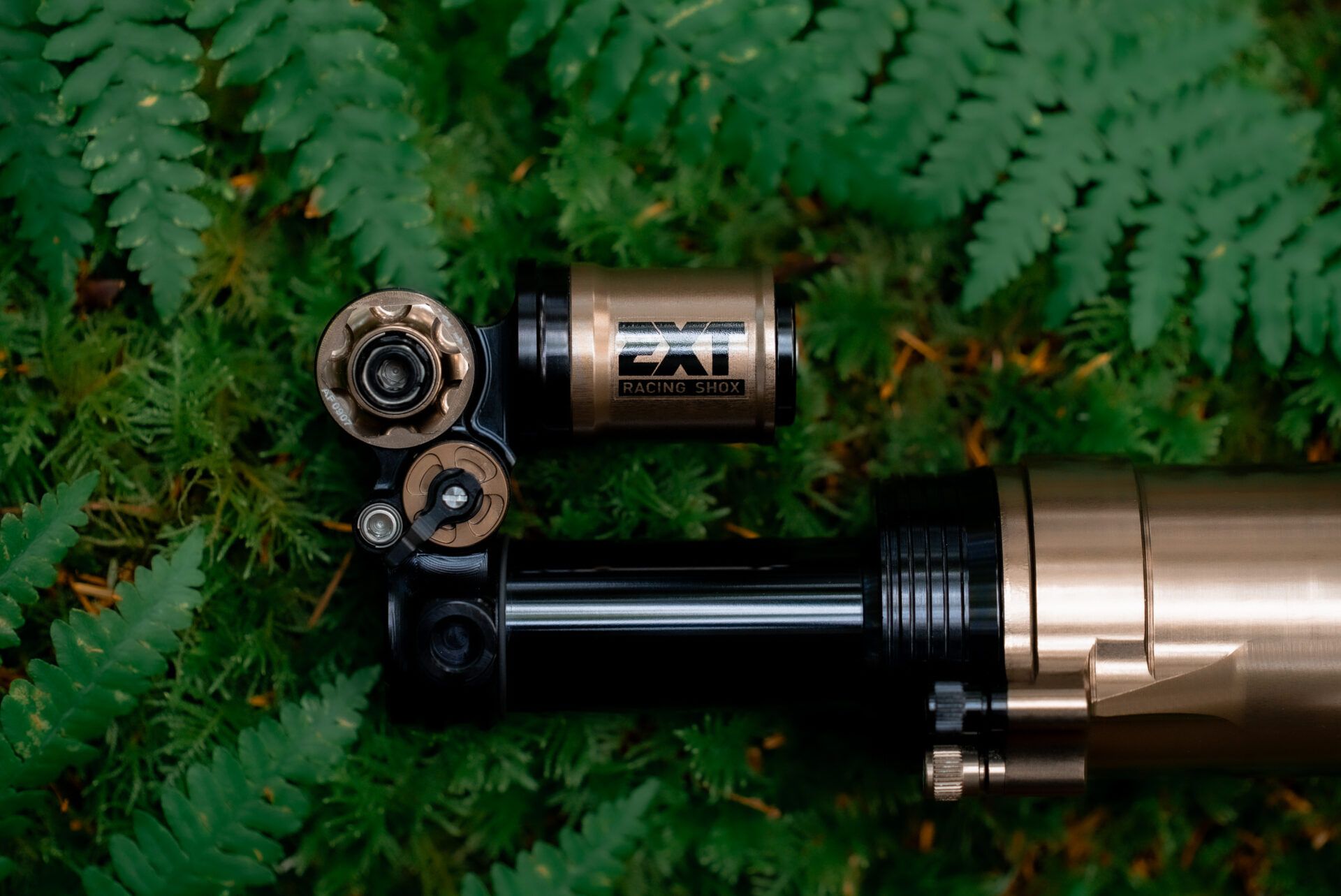
The headline change is packaging. The piggyback reservoir now stands vertically and the valve block is smaller, which EXT says lets the shock fit a wider range of frames — relevant for full-power e-MTBs, where the motor and battery often leave little room around the shock. You can find both models in our EXT Aria V2 and Aria V2 DH catalog entries, and the rest of the range on the EXT brand page.
How the EXT Aria V2 air spring works
The Aria keeps EXT's patented AS3 system with two separate positive air chambers. The + chamber (black valve) sets sag and governs roughly the first 60% of travel, so its pressure follows rider weight and style. The ++ chamber (nickel valve) controls the remaining ~40% and therefore the ramp-up: more pressure gives more mid- and end-stroke support, less gives a more linear feel. EXT's point is that progression is tuned with a pump rather than volume tokens, and a 600 psi shock pump comes in the box. The brand pitches this as a way to match the shock to linear or progressive linkages and to get closer to coil-like sensitivity. If you are weighing those two spring types, our air vs coil explainer covers the basics.
Less friction, same damper core
EXT revised the seal profiles and materials to cut drag through the stroke, and moved the guide bushing inside the shock, where it runs directly in oil. The monotube damper uses the same compression valve as EXT's V4 series, a 14 mm chromoly shaft, EV2S damper fluid and a bladder reservoir pressurised to 55 psi. Adjustments cover high- and low-speed compression, rebound, the LOK 2.0 lockout circuit and adjustable hydraulic bottom-out control (HBC).
What changes on the Aria V2 DH
The DH version gets a dedicated HBC tune that EXT says produces 20% more force at the end of the stroke for big hits, a damping tune for longer strokes, and no LOK lever, since pedalling efficiency matters less on a downhill bike. It is offered only in the longer 230/250 mm standard and 205/225 mm trunnion lengths.
Both shocks are covered by EXT's five-year warranty: the two-year legal warranty plus a three-year extension.
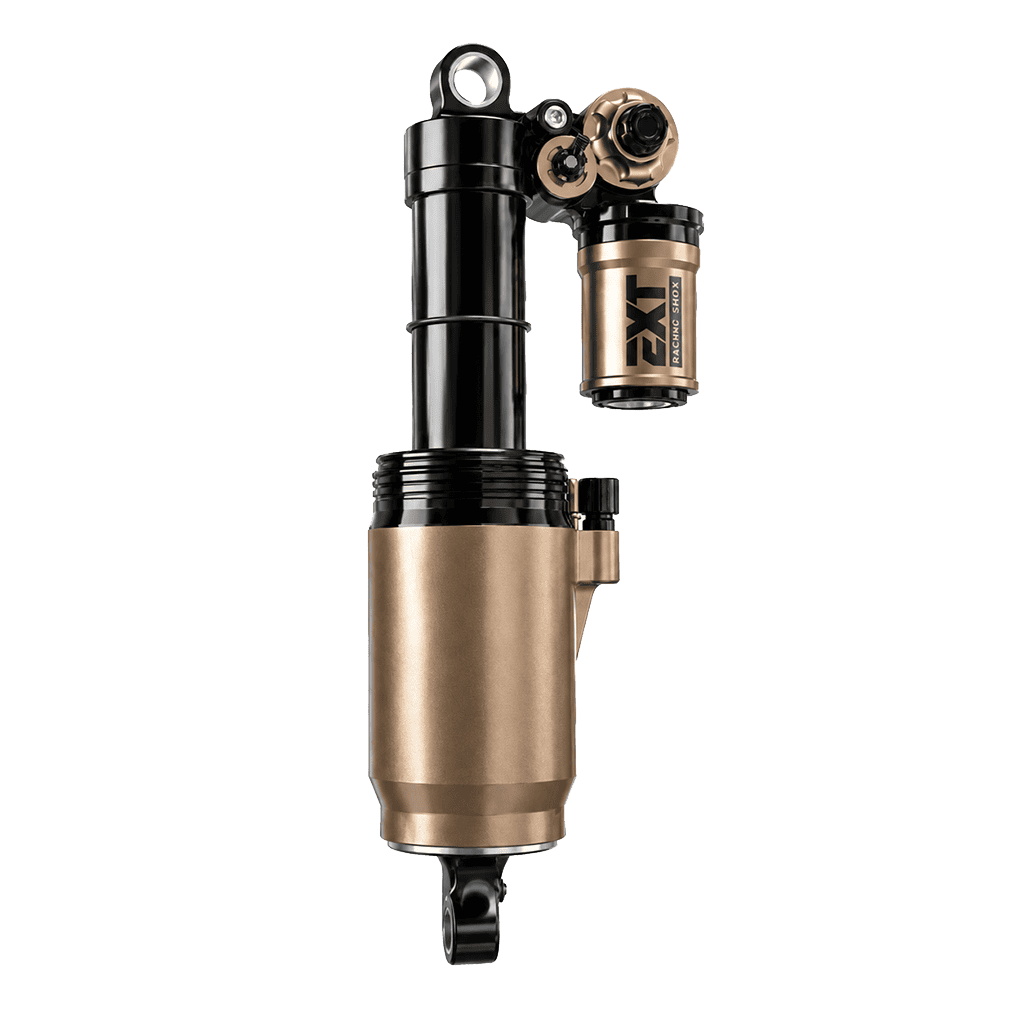
Aria V2 vs Aria V2 DH
| Aria V2 | Aria V2 DH | |
|---|---|---|
| Use | Trail / enduro | Downhill / freeride |
| Metric standard | 210, 230, 250 mm | 230, 250 mm |
| Metric trunnion | 185, 205, 225 mm | 205, 225 mm |
| Strokes | 47.5–75 mm (2.5 mm steps) | 57.5–75 mm (2.5 mm steps) |
| LOK 2.0 lockout | Yes | No |
| HBC tune | Standard | DH, +20% end-stroke force |
| Weight | 622 g (210 × 55) | 667 g (250 × 75) |
| Price | €1,100 / $1,200 | €1,100 / $1,200 |
Shared features
- Air spring
- AS3, dual positive chambers (+ / ++)
- Damper
- Monotube, HSC/LSC and rebound adjustment
- Compression valve
- Same as EXT V4 series
- Shaft
- Ø14 mm chromoly steel
- Reservoir
- Bladder, 55 psi
- Fluid
- EXT EV2S
- In the box
- 600 psi shock pump
Manufacturer data. DH weight as reported by eMTB-News.
Frequently asked questions
How much does the EXT Aria V2 cost?
EXT lists both the Aria V2 and the Aria V2 DH at €1,100 in Europe and $1,200 in the US.
What is new on the Aria V2?
A vertical piggyback and smaller valve block for wider frame compatibility, revised seals and an internal oil-lubricated bushing to reduce friction.
How heavy is the Aria V2?
EXT quotes 622 g for a 210 × 55 mm Aria V2; the Aria V2 DH is reported at 667 g in 250 × 75 mm.
How is the Aria V2 DH different?
It has a downhill HBC tune with 20% more end-stroke force, a long-stroke damping tune, no LOK lockout and only longer shock lengths.
Do I need volume tokens to tune progression?
No. Progression is set with the pressure in the ++ chamber using the 600 psi pump supplied with the shock.
32 years of riding experience — from a school bike to today’s high-tech e-MTBs.